
בְּרֵאשִׁית
BeReshit
Genesis
CHAPTER 24
With Commentaries
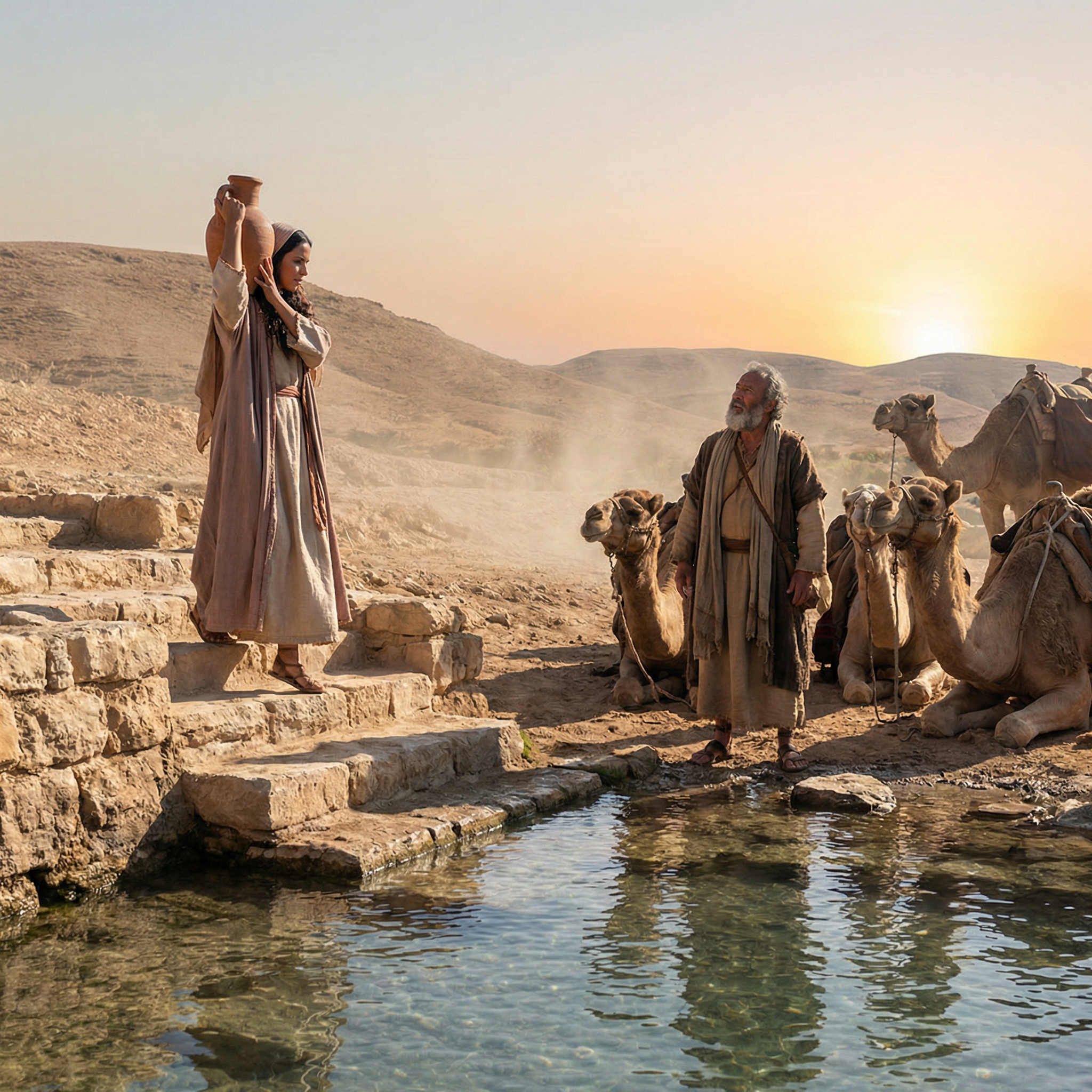
“O YHVH, God of my master Avraham, please grant me success today and show steadfast love to my master Avraham. Behold, I am standing by the spring of water, and the daughters of the men of the city are coming out to draw water. Let the young woman to whom I shall say, ‘Please let down your jar that I may drink,’ and who shall say, ‘Drink, and I will water your camels, ’ let her be the one whom you have appointed for your servant Yitzkhak. By this, I shall know that you have shown steadfast love to my master.”
Listen to this chapter in Hebrew
Ch. 25 ►
And Avraham came into his years and became old, and YHVH blessed Avraham in all/everything.
1
וְאַבְרָהָם זָקֵן בָּא בַּיָּמִים וַיהוָה בֵּרַךְ אֶת־אַבְרָהָם בַּכֹּל׃
א
VeAvraham | Zaken | Ba | BaYamim | VaYHVH | Berakh | Et-Avraham | Bakol
זָקֵן/Zakon
The word “Zakon” means to be old, become old, become old, to grow old, or to show age.
“And Avraham came into his years and became old.”
Avraham had become old and was also showing his age. This is what is meant by telling us this in this verse. When someone shows their age, they are exhibiting the typical physical, mental, or behavioral signs of aging, often in a way that is more noticeable than usual or unexpected for someone who might otherwise seem younger. Symptoms associated with old age include physical changes such as wrinkles, gray hair, thinning skin, decreased muscle/bone density, and sensory loss (vision/hearing). These are only the physical symptoms. Mental symptoms also include cognitive shifts, such as slower thinking and memory issues, and potential mood changes, such as increased loneliness or depression. This is what the Torah is saying about Avraham. Was he showing all of these symptoms? We do not know but that he was showing them? He was. Nobody is exempt from growing old. Some are much faster than others to get there, but we all do. Let us also remember that Avraham was well over one hundred years old by this point.
The last part of the verse tells us that YHVH blessed Avraham in everything he did. So we must study Avraham’s life to see what manner of life he lived, so that we can see him as an example for our lives. Take in the good examples and learn from the bad ones so we can avoid them. This we must do with everyone mentioned in the Hebrew Bible, the Tanakh. This is a way of knowing who YHVH favors in life, who did YHVH bless and who did He punish, and why. This is a way of getting to know our Creator, so we know what sort of person He wants us to be. We can understand this by knowing who He favored and who He did not. In Avraham’s case, he was the kind of person whom YHVH blessed in everything he did.
And Avraham, he said to his servant, the eldest of his house, ruler of all that was his, “Please, put your hand under my thigh,
2
וַיֹּאמֶר אַבְרָהָם אֶל־עַבְדּוֹ זְקַן בֵּיתוֹ הַמֹּשֵׁל בְּכָל־אֲשֶׁר־לוֹ שִׂים־נָא יָדְךָ תַּחַת יְרֵכִי׃
ב
VaYomer | Avraham | El-Avdo | Zekan | Beito | HaMoshel | BeKhol-Asher-Lo | Sim-Na | Yadekha | Takhat | YeRekhi
עֶבֶד/Eved
I have talked about this word before, and its meaning is translated differently in the Bible. The word “eved” is translated as either “servant” or “slave”, which is it? I could say that the translation would differ depending on context, but I do not think so. I am going to say that the translation depends on how the person is treated. If a person is being treated by his employer fairly, it is a servant, and if a person is being forced into labor, stripped of human rights, and mistreated, then it is a slave.
Sometimes translators just put in the word that they think, no, they feel should be there, as an example.
Shemot/Exodus 9:20
The fearful of the command/words of YHVH of the avdey/servants of Pharaoh, fled/hurried their avadaiv/servants and their livestock into the shelter/house.
Same word with two different suffixes, and yet, most likely translated differently in your Bible, it was in all of mine.
So, this servant of Avraham was the eldest of his house and oversaw everything that Avraham owned, as if he were the eldest of his sons. Now we know for sure that Yitzkhak has made his own life apart from Avraham, and Ishmael is no longer in the picture for the family.
In other books of the Torah, we will learn many laws that pertain to servants. How they should be treated, in some cases, how long they should serve, according to their circumstances, how they should serve their house, and how their house should take care of them. There are many laws for servants, so we will study them when we get there, and they are not slaves, at least when it comes to Israel.
and I will make you swear, in YHVH, the Powers/God of heaven, and the Powers/God of the land/earth, that you will not take a wife for my son from the daughter of the Kenanites, with whom I dwell among them.
3
וְאַשְׁבִּיעֲךָ בַּיהוָה אֱלֹהֵי הַשָּׁמַיִם וֵאלֹהֵי הָאָרֶץ אֲשֶׁר לֹא־תִקַּח אִשָּׁה לִבְנִי מִבְּנוֹת הַכְּנַעֲנִי אֲשֶׁר אָנֹכִי יוֹשֵׁב בְּקִרְבּוֹ׃
ג
VeAshbiakha | BaYHVH | Elohey | HaShamayim | VeLohey | HaAretz | Asher | Lo-Tikakh | Isha | Libeni | Mibenot | HaKenaani | Asher | Anokhi | Yoshev | BeKirbo
Why those Avraham make his servant swear with his hand under Avraham’s thigh? The "thigh" (or "loins") was a euphemism for the reproductive organs, signifying an oath sworn by the very source of future generations and God's covenant, making it incredibly serious, much like swearing on one's "seed" or lineage, or at least that is what is believed; Scripture does not say.
“I will make you swear, in YHVH, (who is) the Powers of heaven, and (who is) the Powers of the land/earth.”
By now, I hope you do not wonder why I say "powers" rather than just "God". If you, by chance, came here, to this specific page, you have to go back to the beginning and read and understand this. God is “EL”, and Gods is “Elohim”, in Hebrew, “EL” means Power and “Elohim” means powers with no other language in between, from Hebrew to English. The word "God" comes from Germanic languages and means "deity," any deity. YHVH is where all powers in existence come from, even your power, meaning your existence. Without Him, we would not be alive. So, who is YHVH? All the powers of heaven and all the powers of the world. To say it in today’s language, YHVH is God over heaven and God over all the earth. In this verse, when it comes to who God is over heaven and earth, only His sacred name is mentioned, and no one else.
“that you will not take a wife for my son from the daughter of the Kenanites, with whom I dwell among them.”
I am not going to pretend that I know the reason why Avraham was so opposed to marrying Yitzkhak to a woman of the land. However, you could say that the women of the land did not believe in YHVH and were too rooted in their traditions of other gods. This is a habit too strong to break. Religious tradition is deeply rooted in family memories. However, we must also remember that this is why YHVH took Avraham away from his family and land: he was the only one who believed in YHVH alone, according to the rabbis. So, there is no warranty of the woman from his land to believe the same as Avraham’s family, from Avraham’s perspective, that is. I can also say that Avraham did it because that is the Law of YHVH, spelled out but not written word-for-word in Deuteronomy 7:3-4. In simple terms, a person born to a Jewish mother, no matter the father, is a Jew, but a person born to a Jewish father, but the mother is not Jewish, the baby is not Jewish; therefore, the baby, when it grows up, must convert into the Jewish family. You may ask, then what is the father to the child? The father signifies the baby's tribe or lineage, but does not make the baby Jewish. However, the Law had not been given at the time of Avraham, and I do not think that Avraham could have found a suitable woman for Yitzkhak among the women of the land of Canaan, at least one who was modestly wise. Maybe this is the reason why the Torah explains here the state of Avraham’s old age. Avraham might have been stubborn and difficult in his old age. Do we know for sure Avraham’s reasons? No, we do not. One other thing that comes to mind is that Avraham may know that the Khanaanites are descendants of Kham, Noakh’s son, who was cursed by his father for what he did, and Avraham is a descendant of Shem, Kham’s older brother. Shem was blessed, and Kham was cursed. So, Avraham does not want his son to marry a cursed woman.
Another question: why ask this of his servant and not just tell Yitzkhak? Couldn’t it be more obvious that Yitzkhak has gone his own way, apart from Avraham? And also, Avraham made him promise that he, his servant, would not get a wife for Yitzkhak from the Canaanite woman. Like if it was the servant’s duty to do this after he is dead. One other thing we have to understand is that Avraham was old and most likely could not make a long journey anymore. He is either stuck where he is or does not want himself or Yitzkhak to leave Canaan, the land promised to him and his descendants.
Ibn Ezra (approximately 1089 - 1092 to approximately 1164 - 1167) commentary:
PUT, I PRAY THEE, THY HAND UNDER MY THIGH. Some say that my thigh alludes to Avraham’s circumcised member. However, if this were the case, Avraham should have had him swear by the covenant of circumcision, not by the Lord. I believe that it was customary in those days for a person to place his hand under the thigh of his master, its meaning being, “If you are subject to my authority, place your hand under my thigh.” The lord then sat on his servant’s hand. By doing so, the servant, as it were, said to the master, “My hand is under your authority to do your will.” This custom is still followed in India.
OF THE CANAANITES. This includes all of the eleven Canaanite peoples.
Chizkuni (13th Century) commentary:
“The senior servant of his household,” his servant was old enough so that Avraham did not have to worry that he would take advantage of his position to indulge in incestuous conduct.
תחת ירכי: according to the plain meaning of the word, it has nothing to do with the place where Avraham circumcised himself, although it was the most sacred part of his body. If it had, why did Avraham not make him swear an oath by using it as the focus instead of using Hashem as his focus? It simply was the custom in those days that any person who was subservient to another person would place his hand under the thigh of his master as a symbol that he acknowledged him as such. Having done this was equivalent to a promise to carry out his master’s wishes. This custom was still in use in India in our author’s time.
Kli Yakar (כלי יקר), meaning "precious vessel," refers to a popular Torah commentary written by the Polish rabbi Shlomo Ephraim ben Aaron Luntschitz (1550-1619). Commentary:
Among whom I live. If Yitzchok lived near his wife’s family, either in Canaan or in Charan, he would be subject to their influence. But if he married a woman from Charan and they lived in Canaan, he would not be influenced by them.
Or HaChaim (approximately 1696 - 1743) commentary:
"among whom I dwell." Abraham countered his servant's assumption that, inasmuch as the very proximity of Abraham causes one to be included in the blessing G'd promised to Abraham, this did not mean that one's basic status of being cursed (as a result of Noach's curse) had been revoked. Abraham also wanted to dispel the notion that his presence and status among people such as Aner, Eshkol, and Mamre would be endangered if he did not take a wife for Isaac from their families.
Rabbeinu Bahya (1255 – 1340) commentary:
“that you will not take a wife for my son from amongst the daughters of the Canaanite, etc.” He warned his servant not to take a wife from a cursed nation. When a woman is predestined for destruction, she is apt to drag her husband in the same general direction. This is precisely what the mother of all human beings did (compare Genesis 3:20). You are aware that this is what happened to Solomon, who married a number of alien women (Kings I 11:1). The prophet testifies there that it was these women who turned his heart from being completely loyal to G-d. This is the reason that it has become the custom of the Jewish people to read this portion (in the presence of the assembled guests) to a bridegroom on the day he marries, to remind all the people to be very circumspect in their choice of life-partners. Proverbs 31:30, “grace is deceptive, and beauty is vain.“ He should also not marry a woman because she is wealthy, as money is apt to develop wings and to fly off just like an eagle (compare Proverbs 23:5). The groom should also not marry a woman because she is a member of a powerful and influential family, and he hopes to become powerful and influential himself due to his wife’s connections. If these are a groom’s considerations in the choice of his wife, he will be punished and will likely fail on all three counts. The guiding considerations when choosing a wife are reverence for G-d and a desire for a family with a good reputation. Seeing that, in the majority of cases, the daughter‘s character is similar to that of her brothers, one may form some idea of what a girl is like by observing how her older brothers conduct themselves.
Our portion also teaches that it is appropriate to select a bride from amongst one’s family, as did Avraham (compare verse 4) for his son Yitzchak, and as did Amram, who married Yocheved (an aunt, Exodus 2:1 something that the Torah forbade later on. Whenever people marry someone to whom they already have a natural affinity, such as members of their own family (excluding incest, of course), the likelihood of harmonious relations not only between husband and wife but between the mutual members of the respective families is enhanced.
If someone marries a wife from a lower social stratum, there is a chance that he will feel superior to her, and this will lead to bad blood and resentment on his wife’s part. The result will be ongoing friction. Our sages in Pessachim 49 have described families who are cleaving to one another because they are all part of the same social strata as ענבי הגפן בענבי הגפן דבר נאה ומתקבל, “grapevines joining grapevines are something beautiful and acceptable.” The author continues in this vein, concluding with the quotation from Psalms 125:4 הטיבה ה’ לטובים ולישרים בלבותם, “Do good, O Lord to the good, to the upright in their heart.” The psalmist implores G-d to grant His blessing to people whose motivations in their choice of wife are guided by the principles we have just outlined. The psalm goes on by predicting that those who are guided by base motivations will join the path of the evildoers. When such clear lines of distinction are drawn between people who are sincere in their motivations and those who are not, Israel will be at peace (as one will not confuse one group with another).
Radak (1160-1235) commentary:
ואשביעך..ואלוקי הארץ, meaning that the same G’d Who is ruler in the heavens also exercises His control down here on earth. Do not think that if you do not honour an oath made to G’d in heaven, failure to honour it would not have negative consequences for you here on earth. When Avraham speaks of his own self, as opposed to the need to make someone else take an oath, he only needs to refer to the “G’d of the heavens” (compare verse 7). Avraham was well aware of G’d being also the G’d on earth. In Bereshit Rabbah 59:8, Rabbi Pinchas is quoted as saying that until He revealed Himself to His creatures, G’d was known only as the “G’d of the heavens,” whereas after He revealed Himself to His creatures [or to an individual creature by performing a miracle for such a person Ed.] He also became known as the ”G’d of the earth.”
מבנות הכנעני, for the entire Canaanite tribe is cursed since the days of Noach, and Avraham’s seed is not to be merged with that of a cursed tribe.
but, to my land, and to my kindred/relatives, go, and take a woman/wife for my son, for Yitzkhak.”
4
כִּי אֶל־אַרְצִי וְאֶל־מוֹלַדְתִּי תֵּלֵךְ וְלָקַחְתָּ אִשָּׁה לִבְנִי לְיִצְחָק׃
ד
Ki | El-Artzi | VeEl-Moladti | Telekh | VeLakakhta | Isha | Livni | LeYitzkhak
Avraham told his servant not take a wife from the Kenaanites for Yitzkhak, his son, but to go to his kindred or his relatives to procure a wife for his son Yitzkhak. Avraham was very specific about this. The woman that his servant should choose has not only to be from the land Avraham came from, meaning Kharan, because that is where his family moved to, but also a relative of the family. Avraham seems very opposed to Yitzkhak marrying a woman from the people he lives among, meaning the Kenaanites. It could be the course set for them by Noakh; it could be that he thinks the women from his land share his values, or it could mean he wants to keep the bloodline pure. We do not know for sure. What do I think? Ok, because Avraham singled out the people or the women he lived with, meaning the Kenaanites, it would seem that their customs and way of being are something he does not desire. If Avraham lets things be, Yitzkhak will probably end up marrying a Kenaanite woman. So, he is taking matters into his own hands. Avraham is probably thinking of alternatives, and the best choice would be a woman from his own land and family. Whatever the reason, this is what Avraham chose to do. However, we do not know for sure.
Ibn Ezra (approximately 1089 - 1092 to approximately 1164 - 1167) commentary:
BUT THOU SHALT GO UNTO MY COUNTRY. To Haran, where he had once dwelt.
AND TO MY KINDRED. Ur of the Chaldees.
Chizkuni (13th Century) commentary:
“to my homeland,” i.e., to Charan.
“to my birthplace,” i.e., Ur Casdim. Avraham told his servant that he did not want any gentile woman to have a share in his ancestral portion.
Or HaChaim (approximately 1696 - 1743) commentary:
"rather you shall go to my country and to my birthplace, etc." This was part of the oath also; his servant was to secure a wife for Yitzkjak in Abraham's birthplace. This is why his servant is described as immediately taking the camels, etc.
The Torah: A Women's Commentary (Copyright © 2008) commentary:
“A wife for my son.” The word for “wife,” ishah, also means “woman.” It recurs frequently in these verses, emphasizing Abraham’s fear that Yitzkhak will marry the “wrong” woman.
And the servant, he said to him, “Perhaps the woman is not willing to follow after me to this land. Shall I return your son to the land from which you came?”
5
וַיֹּאמֶר אֵלָיו הָעֶבֶד אוּלַי לֹא־תֹאבֶה הָאִשָּׁה לָלֶכֶת אַחֲרַי אֶל־הָאָרֶץ הַזֹּאת הֶהָשֵׁב אָשִׁיב אֶת־בִּנְךָ אֶל־הָאָרֶץ אֲשֶׁר־יָצָאתָ מִשָּׁם׃
ה
Vayomer | Elaiv | HaEved | Ulai | Lo-Tove | HaIsha | LaLekhet | Akharai | El-HaAretz | HaZot | HeHaShev | Ashiv | Et-Binkha | El-HaAretz | Asher-Yatzata | Misham
The servant took his job seriously; he did not want to make any mistakes and was thinking ahead in case things did not go right, as things tend to happen in life. If the woman that he finds, whoever she might be, did not want to leave the land she is from, or her family, then what is he to do? Take her by force? Look for another one? He asked because he did not want to make a decision himself. He wanted Avraham to make that decision. The servant came out with another possibility that he knew Avraham was not comfortable with, and that is to take Yitzkhak with him to Avraham’s land. It is human nature to think this way, at least by prepared, conscious people. People who care for their family and jobs. If Avraham’s servant was not taking his job and his promise seriously, he would not have asked any questions and would have just left, thinking nothing might go wrong. This is what people with no forethought do. They do not think ahead, and when things go wrong, they do not know what to do. They are making a decision on their own, which is most likely not the right one. When someone cares about the possibilities of their outcome and prepares for any eventuality, this says a lot about a person's character.
The servant asked Avraham if the woman would not agree to come. Was he to take Yitzkhak to that land? This is reasonable thinking. After all, he is just the servant, and Yitzkhak is the master of the servant. If the woman he chooses did not want to come with him, then the next step would be to take Yitzkhak to the woman.
“Shall I return your son to the land from which you came?”
Why would the servant say, “Shall I return your son,” if Yitzkhak has never been to that land, at least that we know of? This is because Avraham and Yitzkhak are Hebrews, meaning they are strangers in the land of Kenaan. Yes, Avraham is now a citizen of Kenaan, but his roots and those of his family are not from Kenaan; they are from where Avraham is from. Let us say that Yitzkhak wanted to move to Kharan, from which Avraham is from, then he would say, “I will return to the land of my father,” even if he had never been to that land before. This is because he would be going to the land of his roots, his family, and his father’s roots. Which are also his roots.
Ramban (1194-1270) commentary:
PERADVENTURE THE WOMAN WILL NOT BE WILLING. The meaning [of the definite article in the word ha’ishah] is that it refers to “the woman to whom I will speak of all the women there”, or it may mean the woman who is fit for Isaac.
Sforno (approximately 1470/1475-1549) commentary:
אשר יצאת משם, a place which you had despised. If I now swear to you to take a wife from there and the girl I choose refuses to come here, my betrothing her to your son will obligate him to fulfill his conjugal duties, including living with her as husband and wife. If he refuses to join her there, he will have become guilty of betrayal of his bride. Shall I really bring him back there?
Chizkuni (13th Century) commentary:
“Shall I really take back your son there? This is a peculiar question by the servan, as Yitzkhak had never been out of the land of Kanaan. Seeing that the servant had been sent back there on behalf of Yitzkhak, his question was perfectly in order. We find a similar verse in Ruth 1:22, where Naomi is described as “returning” to the land of Israel with her daughter-in-law, although the daughter-in-law, Ruth, had never set foot in that land.
Radak (1160-1235) commentary:
Supposing that by the time I return from my mission, you will no longer be alive, tell me if I should bring your son back there in the event that the girl I select refuses to move here? Even though Yitzkhak was not present during this discussion, the servant calls his potential migration to Aram Naharayim a השבה, “return,” referring to Avraham, who had left that region, not to Yitzkhak, who had never been there in the first place.
Rashbam (approximately 1085 – approximately 1158) commentary:
To the land of your ancestors? He meant that even though he might not find any members of Avraham’s former family there. He still referred to this as a השבה “a return.”
Steinsaltz (1937-2020) commentary:
The servant said to him: Perhaps the woman will not wish to follow me to this land, as it is a long journey to Kanaan from Kharan, which is located on the southern border of modern-day Turkey. What should I do if she refuses to leave her home to come here? Shall I return your son to the land from which you departed?
The Torah: A Women's Commentary (Copyright © 2008) commentary:
“Suppose the woman does not care to.” Literally, “perhaps the woman will be unwilling.” The servant’s question implies that the woman can legally choose to refuse. A woman cannot simply be “taken.”
Tur HaAroch (Approximately 1270–1340) commentary:
“Perhaps the woman does not want, etc.” He was referring to what might happen after he had located a girl he considered suitable as Yitzchak's future wife.
And Avraham, he said to him, “For you, be careful/beware, lest you return my son there.
6
וַיֹּאמֶר אֵלָיו אַבְרָהָם הִשָּׁמֶר לְךָ פֶּן־תָּשִׁיב אֶת־בְּנִי שָׁמָּה׃
ו
Vayomer | Elaiv | Avraham | HiShamer | LeKha | Pen-Tashiv | Et-BeNi | Shama
פֶּן־/Pen
This word means, lest, not, or beware lest.
“For you, be careful/beware, lest.”
The word “lest” shows the intention of preventing something undesirable or to avoid the risk of doing something. Avraham seems to be either threatening or warning his servant not to take his son, Yitzkhak, outside Khenaan. However, as we know Avraham as a good man who cares for others, we are inclined to say that he was warning his servant with concern for him and his son Yitzkhak. In the next verse, Avraham will give his reason for this. The only thing I will say right now is that Avraham has learned from experience that leaving the promised land for him and his descendants is not a good idea. This he has learned over time, and it was not told to him by YHVH. Every time Avraham ventured outside the promised land, he was met with misfortune. His wife, Sarah, being kidnapped twice, in two different ocations is one example.
This is what this part of the Torah is telling us: Avraham, as well as the other prophets, spoke to YHVH or Elohim, but we do not. However, we must learn to listen with more than our ears. Just like Avraham did. As he learned not go out of the promised land. Sometimes we want things that YHVH does not want us to have, or we are not ready for, at that point in our lives, and we must learn to see this without being told. I can only tell you this from one of my own live experiences in which I am sure YHVH Elohim has interceded for me, and I am sure He has for you as well. He was telling me what to do, and I just had to listen with more than my ears. I was in the market for my first house, and I found one that my family and I liked very much. The house was beautiful with a big lot. So, we made an offer slightly under the asking price, but we were denied. Next, we offered the asking price, and we were denied again. We did not know what was going on or what the problem was. So, we moved on. After we saw a few more houses, we came to look at this house that as soon as I saw it, with this big tree in the front yard, I felt something. As I walked inside, I felt a sense of peace, but I did not immediately recognize it. Every breath felt like a deep breath, filling my lungs with satisfaction and peace, and to say that of a house with the air conditioning off in the middle of the desert summer is saying something. Heat of over one hundred degrees. The house was cool and inviting. I told this to our real estate agent, and he said, “You have some imagination”. We again made an offer slightly under the asking price, and the seller accepted it. Next came the inspection, and there were a few concerns. The seller said I will take care of them immediately, and he did. The financial side went just as easily. It was like things were stacking in my favor. Before I started looking for a house, many family members and friends told me, based on their experience, that it would take a long time to find and buy one. However, in all it took two to three months. Some people may say, “You were lucky,” or “You were at the right place at the right time.” I do not think so. I think that if I stubbornly had tried to get the one house that I first liked for its looks and big yard, I would not have been happy there, for only YHVH knows why. Was Elohim guiding me at that time? Who can say for sure? All I know is that it felt like it. We must learn to listen with more than our ears, with patience and an open mind. Not everything that we want, we must have.
Ibn Ezra (approximately 1089 - 1092 to approximately 1164 - 1167) commentary:
[BEWARE.] When the word hishamer (beware) is penultimately accented, it is related to the word shemirah (watching, guarding). However, when it is ultimately accented, it is related to the word shemarim (lees). Compare hishamer (keep calm) in Keep calm (hishamer), and be quiet (Is. 7:4), which has the same basic meaning as shemarav (his lees) in And he hath settled on his lees (shemarav) (Jer. 48:11).
Rabbeinu Bahya (1255 – 1340) commentary:
“lest you bring my son back there.” The meaning is “do not lead him back there.” Avraham did not want Yitzkhak to leave the boundaries of the Holy Land. This was because he had once been designated a sacred offering, and something sacred must not be desecrated by being returned to a secular status.
Radak (1160-1235) commentary:
For Avraham did not want the claim on the land of Yisrael, which G’d had promised him and which had been established through his physical presence in that land, to become subject to doubt through an even temporary migration of Yitzkhak.
פן תשיב, so that you do not bring back. We find a similar formulation in Genesis 3,3 פן תמותון, “so that you will not die,” and in Genesis 31:24 פן תדבר עם יעקב, “so that you will not speak with Yaakov, etc.”
Steinsaltz (1937-2020) commentary:
“Abraham said to him: Beware lest you return my son there.” It was not my choice to distance myself from the land of my birth.
The Torah: A Women's Commentary (Copyright © 2008) commentary:
6–8. Avraham’s response introduces a key biblical concept: the special bond between the family of the patriarchs and the land of Israel.
YHVH, the Powers/God of the heavens, took me from my father’s house and from the land of my relatives/family, and spoke to me, and swore to me, saying, ‘To your seed/descendants I give this land.’ He will send His messenger/representative/angel to be before you and take a woman/wife for my son from there.
7
יְהוָה׀ אֱלֹהֵי הַשָּׁמַיִם אֲשֶׁר לְקָחַנִי מִבֵּית אָבִי וּמֵאֶרֶץ מוֹלַדְתִּי וַאֲשֶׁר דִּבֶּר־לִי וַאֲשֶׁר נִשְׁבַּע־לִי לֵאמֹר לְזַרְעֲךָ אֶתֵּן אֶת־הָאָרֶץ הַזֹּאת הוּא יִשְׁלַח מַלְאָכוֹ לְפָנֶיךָ וְלָקַחְתָּ אִשָּׁה לִבְנִי מִשָּׁם׃
ז
YHVH | Elohey | HaShamayim | Asher | LeKakhani | Mibeit | Avi | UMeEretz | Moladti | VaAsher | Diber-Li | VaAsher Nishba-Li | Lemor | LeZarakha | Eten | Et-HaAretz | Hazot | Hu | Yishlakh | Malakho | LeFaneikha | VeLakakhta | Isha | Livney | Misham
Avraham is stating who spoke to him: YHVH, He who is all the Powers of the heavens. He, YHVH, is the one who promised him, Avraham, and his descendants after him the land of Yisrael, and it belongs to them, the Israelites, forever. This might be another reason why Avraham does not want to leave Khenaan. He might fear that the promise would be void if he or any of his descendants left the promised land. Kind of abandoning the land and the promise. YHVH did not say they could not leave Khenaan, but Avraham had learned from experience.
“Took me from my father’s house and from the land of my relatives/family.”
Among the commentators, it is discussed where Avraham’s servant went to find a wife for Yitzkhak, and later we will find out that he went to Haran. However, the first time we learned from Avraham was that he was in Ur of the Chaldeans with his father and family. Does this mean that the servant should had gon to Ur and not to Haran? The fact that the servant goes to Haran means that that land is where Avraham’s people came from. Why was he in Ur when we first learned of him? Let us remember that the people of Ur were founded by the very successful conqueror Nimrod. He who was given power by YHVH to test the people after the Great Flood. All sorts of people were flocking to that land because it was prosperous. Just like many people do, they go to another country when they are not doing well in their own and are looking for a better life. Besides, Avraham’s servant had to go to Avraham’s family, and it does not matter where they were at the time, or where Avraham’s family were from, Avraham’s family were in Haran. Let us also remember that Avraham was told that his brother had a family as well, and this is precisely to whom the servant went. To Avraham’s only brother who was alive.
Now, Avraham told his servant that YHVH would send His messenger, His representative, this entity that we now know as an angel, to go before him, or ahead of him, and he would choose this woman who would be Yitzkhak’s wife. So, Avraham’s servant must not worry at all.
Rashi (approximately 1040 - approximately 1105) commentary:
THE LORD, GOD OF HEAVEN, WHO TOOK ME FROM MY FATHER'S HOUSE — Here he did not say “[The God of heaven] and the God of the earth”, whereas above (v. 3) he said, “And I will make thee swear etc. … [and the God of the earth]’’. But, in effect, Abraham said to him: Now He is the God of heaven and the God of the earth, because I have made him (i. e. His Name) a familiar one in peoples’ mouths: but at the time when He took me from my father’s house He was God of heaven only and not God of the earth for people did not acknowledge Him and His Name was not commonly known on earth.
FROM MY FATHER’S HOUSE — from Haran.
AND FROM THE LAND OF MY NATIVITY — from Ur-Kasdim.
Ibn Ezra (approximately 1089 - 1092 to approximately 1164 - 1167) commentary:
HE WILL SEND HIS ANGEL BEFORE THEE. This is a prayer. If it were a prophecy, Avraham would not have said, And if the woman be not willing to follow thee (v. 8).
Ramban (1194-1270) commentary:
FROM MY FATHER’s HOUSE, ‘UMEI’ERETZ MOLAD’TI’ (AND FROM THE LAND OF MY NATIVITY). Rashi comments: “From my father’s house — from Haran. And from the land of my nativity — from Ur of the Chaldees.” If this is so, the expression, Unto my country and to ‘molad’ti’ thou shalt go, must also refer to Ur of the Chaldees. But Heaven forbid that the sacred seed should mix with the sons of Ham, the sinful one! Even if one would say that Abraham had some family there from the seed of Shem, the fact is, however, that the servant went to Haran as his master said! Now perhaps the Rabbi [Rashi] thinks that eretz molad’to(the land of his birth) was Ur of the Chaldees, but molad’ti means “my family,” and my country means the land wherein he lived. But all these are futile words since here, in the verse before us, he said, And thou shalt take a wife for my son from there, [and according to Rashi, who explained ume’eretz molad’ti, mentioned in this verse, as meaning Ur of the Chaldees, it would follow that Avraham commanded his servant to go there to get a wife from the children of Kham]! Moreover, Avraham stayed in the land of Canaan for a longer period than he did in Haran, and so why should Haran be called his country simply because he lived there for some time? Instead, the meaning of the expression, unto my country and to ‘molad’ti’, is “unto my country in which I was born,” [namely, Haran in Mesopotamia], for there he stayed, and from there his ancestors came, as was already explained. In Bereshith Rabbah we find: “From my father’s house — this is the house of his father. And from the land of my birth — this is the environs [of his father’s house].”
It is possible that unto my country and unto ‘molad’ti’ means “Unto my country and unto my family,” for he did not want a wife to be taken for Yitzkhak even from the people of his country but only from his family. Similarly, in the verse, And thou shalt take a wife for my son from there, [the word misham (from there)] alludes to the expression, from my father’s house, mentioned at the beginning of the verse. And so did the servant say when quoting Avraham, And thou shalt take a wife for my son of my family, and of my father’s house, and again he said, quoting his master. Then shalt thou be clear from my oath when thou comest to my family. These words were said by the servant to honor them so that they would listen to him.
Sforno (approximately 1470/1475-1549) commentary:
May it be the will of the Lord that He will send His angel from the celestial regions. Seeing that it was He who had taken me from there, and that all events are under His constant supervision, He will not arrange matters so that my son would be legally obligated to migrate to that land.
Seeing that He made me this promise reinforced by an oath, I am certain that He will not renege on it. [even if I were to fall out of favour in His eyes due to my own fault. Ed.] He will see to it that my son will be able to marry a suitable soul-mate and thus make His oath come true.
Chizkuni (13th Century) commentary:
“Who has taken me out of my father’s house;” He removed me from my relatives in order to give me this land, and He certainly would not want me to return my descendants to the land which He had taken me out of. This is why I am so certain that He will send His angel before you to make your mission successful. Why else would He have brought me to this country, if not in order to be able to fulfill His promise to give this country to my descendants?
Rashbam (approximately 1085 – approximately 1158) commentary:
The One Who has brought me here and has granted me seed in this country (whereas previously I had no offspring), He surely would not want me to now bring back my son to the land He made me leave. If He did, what point was there in His making me move here in the first place?
This is why I am certain that ישלח מלאכו, He will send His angel to make your mission successful, ensuring that He can fulfill His promise.
And if the woman is not willing to follow after you, then you will be clear from this, my oath; only return not my son there.”
8
וְאִם־לֹא תֹאבֶה הָאִשָּׁה לָלֶכֶת אַחֲרֶיךָ וְנִקִּיתָ מִשְּׁבֻעָתִי זֹאת רַק אֶת־בְּנִי לֹא תָשֵׁב שָׁמָּה׃
ח
VeIm־Lo | Tove | HaIsha | LaLekhet | Akhareikha | VeNikita | MiShevuati | Zot | Rak | Et־BeNi | Lo | Tashev | Shama
“And if the woman is not willing to follow after you.”
The key word here is the word "the." The word "the" means that this is one specific woman. This phrase is just like when you say, "Take the child to the house." In this example, both the speaker and the listener are fully aware of the child's identity and the specific house in question. In Avraham’s case, Avraham does not know who the woman will be, but in the previous verse, he said, “He will send His messenger/representative/angel to be before you and take a woman/wife for my son from there.” In other words, the messenger of YHVH will choose the woman, not the servant. The servant will not have to be roaming the streets looking for a woman suitable for his master, Yitzkhak. Avraham's faith in YHVH and his messenger was shown when he said, "And if the woman is not willing to follow you, then you will be clear from this oath.” Avraham can tell his servant that if the woman doesn't follow him, he'll be free of the oath because he knows everything will go well. Then you might ask why Avraham said, “Do not return my son there." Avraham was finishing answering the question that the servant asked back in verse 5, “Perhaps the woman is not willing to follow after me to this land. Shall I return your son to the land from which you came?” In simple words, Avraham’s answer was NO. Why? Because he would not need to, YHVH’s messenger would have everything ready for him, as we will see. We cannot forget that Avraham is a prophet of YHVH.
As you will see, the commentators have a very different idea when it comes to this verse. All I will say is this: If Avraham's servant cannot find a woman for Yitzkhak, he must not take Yitzkhak to Haran for any reason. Do we know if there are any other plans in case this one doesn't work out? No, we don't know of any other plans that we can see from Scripture. All we know is that this was the decision he made and the actions Avraham took.
Rashi’s (approximately 1040 - approximately 1105) commentary:
THEN SHALT THOU BE CLEAR FROM THIS MY OATH, etc., and take a wife for him from the daughters of Aner or Eshcol or Mamre.
Ramban's (1194-1270) commentary:
THEN THOU SHALT BE CLEAR FROM THIS MY OATH. Abraham did not permit him to take a wife for Yitzkhak from the daughters of Canaan, but he would be free [from the oath if Yitzkhak were to do it on his own] and the Eternal do that which is good in His sight.
But Rashi wrote, “And take a wife for him from the daughters of Aner, Eshkol, or Mamre.” Now if they were Canaanites, far be it from him! And in truth, they were of the seed of Canaan, for Scripture says, "Mamre the Amorite, brother of Eshkol and brother of Aner." And in Bereshith Rabbah, the Rabbis have said, "That thou shalt not take a wife," etc. He warned him against the daughters of Canaan, Aner, Eshkol, and Mamre. For it was with reference to Aner, Eshkol, and Mamre that Abraham said, “Among whom I dwell," since he did not dwell among all the Canaanites, as they were many nations. But he warned him against these, his confederates, and all the more against the others. But the verse, “Then thou shalt be clear from this my oath," means that the servant would be free from the oath if Yitzkhak chose to do it on his own. Abraham relied on his knowledge that his righteous son Yitzkhak would listen to him and would be cautious, choosing instead to go to Ishmael, Lot, or the other nations.
My oath might serve as a hint to what he said, "And thou shalt take a wife unto my son from there," since the oath may cover two points: a) that he should not take a wife from the daughters of Canaan, and b) that he should go to his family. In case they refused, he would be free from the second oath, while the first oath would always remain in effect. Accordingly, then, thou shalt understand that my oath concerns something other than what Abraham told him: “Thou shalt not take a wife unto my son of the daughters of the Canaanites” [since he never freed him from this oath]. This explains the word "zoth" (this), [thou shalt be clear from ‘this’ my oath, implying there was another oath from which he was not freed]. Therefore, the servant said, “That I may turn to the right hand or to the left," but instead said, "I would return [to the land of Canaan," since he remained bound by the oath not to take a wife from the daughters of Canaan].
Or HaChaim's (approximately 1696-1743) commentary:
"and you will be relieved of this oath of mine." This means that Eliezer will be relieved of the duty to take a wife for Isaac from Abraham's birthplace; the oath not to take a wife for Isaac from the local Canaanites would remain in force, however, seeing it was something under his control.
Steinsaltz's (1937-2020) commentary:
And if the woman will not wish to follow you, you shall be absolved from this oath of mine, and you need not continue searching for a wife for Isaac; only you shall not return my son there, as he must remain in this land. God gave me this land, and He commanded me to dwell here; therefore, my son may not leave it either.
Tur HaAroch (Approximately 1270–1340) commentary:
"And you will be absolved from this oath to me.” According to Rashi, this implied that under the circumstances just described, Eliezer would be free to take one of the daughters of Oner, Eshkol, or Mamre, Avraham’s closest allies in the land of Canaan. Nachmanides is appalled at the thought that Avraham would have given his consent for Yitzchok to marry a daughter of these Canaanites, the Torah having described Mamre specifically as an Emorite (Genesis 14:13). In fact, according to Bereshit Rabbah, the warning not to marry Canaanite girls was aimed especially at these girls of Oner Eshkol and Mamre, as Avraham had specifically described himself as dwelling in their land. (quoting from Eliezer’s speech at the house of Bethuel). Therefore, Avraham’s warning was directed specifically at girls from Yitzchok’s immediate environment. Seeing that Avraham entertained covenantal relations with these three Emorites, it would have seemed natural to reinforce such ties through intermarriage between these families. It is quite possible that Eliezer’s oath applied to all Canaanites and that although Eliezer would be released from the part of the oath directing him to find a wife for Yitzchok from Avraham’s family, he would not be released from the part forbidding him to select a Canaanite wife for him. This is why Avraham did not say (comprehensively) “you will then be released from your oath,” but משבועתי זאת, “from this (part) oath.” Eliezer had also threatened to “turn right or left"; he threatened to look beyond Canaan. He could have had in mind either Ishmael or the family of Lot.
9
וַיָּשֶׂם הָעֶבֶד אֶת־יָדוֹ תַּחַת יֶרֶךְ אַבְרָהָם אֲדֹנָיו וַיִּשָּׁבַע לוֹ עַל־הַדָּבָר הַזֶּה׃
ט
10
וַיִּקַּח הָעֶבֶד עֲשָׂרָה גְמַלִּים מִגְּמַלֵּי אֲדֹנָיו וַיֵּלֶךְ וְכָל־טוּב אֲדֹנָיו בְּיָדוֹ וַיָּקָם וַיֵּלֶךְ אֶל־אֲרַם נַהֲרַיִם אֶל־עִיר נָחוֹר׃
י
11
וַיַּבְרֵךְ הַגְּמַלִּים מִחוּץ לָעִיר אֶל־בְּאֵר הַמָּיִם לְעֵת עֶרֶב לְעֵת צֵאת הַשֹּׁאֲבֹת׃
יא
12
וַיֹּאמַר׀ יְהוָה אֱלֹהֵי אֲדֹנִי אַבְרָהָם הַקְרֵה־נָא לְפָנַי הַיּוֹם וַעֲשֵׂה־חֶסֶד עִם אֲדֹנִי אַבְרָהָם׃
יב
13
הִנֵּה אָנֹכִי נִצָּב עַל־עֵין הַמָּיִם וּבְנוֹת אַנְשֵׁי הָעִיר יֹצְאֹת לִשְׁאֹב מָיִם׃
יג
14
וְהָיָה הַֽנַּעֲרָ אֲשֶׁר אֹמַר אֵלֶיהָ הַטִּי־נָא כַדֵּךְ וְאֶשְׁתֶּה וְאָמְרָה שְׁתֵה וְגַם־גְּמַלֶּיךָ אַשְׁקֶה אֹתָהּ הֹכַחְתָּ לְעַבְדְּךָ לְיִצְחָק וּבָהּ אֵדַע כִּי־עָשִׂיתָ חֶסֶד עִם־אֲדֹנִי׃
יד
15
וַיְהִי־הוּא טֶרֶם כִּלָּה לְדַבֵּר וְהִנֵּה רִבְקָה יֹצֵאת אֲשֶׁר יֻלְּדָה לִבְתוּאֵל בֶּן־מִלְכָּה אֵשֶׁת נָחוֹר אֲחִי אַבְרָהָם וְכַדָּהּ עַל־שִׁכְמָהּ׃
טו
16
וְהַנַּעֲרָ טֹבַת מַרְאֶה מְאֹד בְּתוּלָה וְאִישׁ לֹא יְדָעָהּ וַתֵּרֶד הָעַיְנָה וַתְּמַלֵּא כַדָּהּ וַתָּעַל׃
טז
17
וַיָּרָץ הָעֶבֶד לִקְרָאתָהּ וַיֹּאמֶר הַגְמִיאִינִי נָא מְעַט־מַיִם מִכַּדֵּךְ׃
יז
18
וַתֹּאמֶר שְׁתֵה אֲדֹנִי וַתְּמַהֵר וַתֹּרֶד כַּדָּהּ עַל־יָדָהּ וַתַּשְׁקֵהוּ׃
יח
19
וַתְּכַל לְהַשְׁקֹתוֹ וַתֹּאמֶר גַּם לִגְמַלֶּיךָ אֶשְׁאָב עַד אִם־כִּלּוּ לִשְׁתֹּת׃
יט
20
וַתְּמַהֵר וַתְּעַר כַּדָּהּ אֶל־הַשֹּׁקֶת וַתָּרָץ עוֹד אֶל־הַבְּאֵר לִשְׁאֹב וַתִּשְׁאַב לְכָל־גְּמַלָּיו׃
כ
21
וְהָאִישׁ מִשְׁתָּאֵה לָהּ מַחֲרִישׁ לָדַעַת הַהִצְלִיחַ יְהוָה דַּרְכּוֹ אִם־לֹא׃
כא
font
22
וַיְהִי כַּאֲשֶׁר כִּלּוּ הַגְּמַלִּים לִשְׁתּוֹת וַיִּקַּח הָאִישׁ נֶזֶם זָהָב בֶּקַע מִשְׁקָלוֹ וּשְׁנֵי צְמִידִים עַל־יָדֶיהָ עֲשָׂרָה זָהָב מִשְׁקָלָם׃
כב
23
וַיֹּאמֶר בַּת־מִי אַתְּ הַגִּידִי נָא לִי הֲיֵשׁ בֵּית־אָבִיךְ מָקוֹם לָנוּ לָלִין׃
כג
24
וַתֹּאמֶר אֵלָיו בַּת־בְּתוּאֵל אָנֹכִי בֶּן־מִלְכָּה אֲשֶׁר יָלְדָה לְנָחוֹר׃
כד
25
וַתֹּאמֶר אֵלָיו גַּם־תֶּבֶן גַּם־מִסְפּוֹא רַב עִמָּנוּ גַּם־מָקוֹם לָלוּן׃
כה
26
וַיִּקֹּד הָאִישׁ וַיִּשְׁתַּחוּ לַיהוָה׃
כו
27
וַיֹּאמֶר בָּרוּךְ יְהוָה אֱלֹהֵי אֲדֹנִי אַבְרָהָם אֲשֶׁר לֹא־עָזַב חַסְדּוֹ וַאֲמִתּוֹ מֵעִם אֲדֹנִי אָנֹכִי בַּדֶּרֶךְ נָחַנִי יְהוָה בֵּית אֲחֵי אֲדֹנִי׃
כז
28
וַתָּרָץ הַנַּעֲרָ וַתַּגֵּד לְבֵית אִמָּהּ כַּדְּבָרִים הָאֵלֶּה׃
כח
29
וּלְרִבְקָה אָח וּשְׁמוֹ לָבָן וַיָּרָץ לָבָן אֶל־הָאִישׁ הַחוּצָה אֶל־הָעָיִן׃
כט
30
וַיְהִי׀ כִּרְאֹת אֶת־הַנֶּזֶם וְאֶת־הַצְּמִדִים עַל־יְדֵי אֲחֹתוֹ וּכְשָׁמְעוֹ אֶת־דִּבְרֵי רִבְקָה אֲחֹתוֹ לֵאמֹר כֹּה־דִבֶּר אֵלַי הָאִישׁ וַיָּבֹא אֶל־הָאִישׁ וְהִנֵּה עֹמֵד עַל־הַגְּמַלִּים עַל־הָעָיִן׃
ל
31
וַיֹּאמֶר בּוֹא בְּרוּךְ יְהוָה לָמָּה תַעֲמֹד בַּחוּץ וְאָנֹכִי פִּנִּיתִי הַבַּיִת וּמָקוֹם לַגְּמַלִּים׃
לא
32
וַיָּבֹא הָאִישׁ הַבַּיְתָה וַיְפַתַּח הַגְּמַלִּים וַיִּתֵּן תֶּבֶן וּמִסְפּוֹא לַגְּמַלִּים וּמַיִם לִרְחֹץ רַגְלָיו וְרַגְלֵי הָאֲנָשִׁים אֲשֶׁר אִתּוֹ׃
לב
33
וַיִּישֶׂם לְפָנָיו לֶאֱכֹל וַיֹּאמֶר לֹא אֹכַל עַד אִם־דִּבַּרְתִּי דְּבָרָי וַיֹּאמֶר דַּבֵּר׃
לג
34
וַיֹּאמַר עֶבֶד אַבְרָהָם אָנֹכִי׃
לד
35
וַיהוָה בֵּרַךְ אֶת־אֲדֹנִי מְאֹד וַיִּגְדָּל וַיִּתֶּן־לוֹ צֹאן וּבָקָר וְכֶסֶף וְזָהָב וַעֲבָדִם וּשְׁפָחֹת וּגְמַלִּים וַחֲמֹרִים׃
לה
36
וַתֵּלֶד שָׂרָה אֵשֶׁת אֲדֹנִי בֵן לַאדֹנִי אַחֲרֵי זִקְנָתָהּ וַיִּתֶּן־לּוֹ אֶת־כָּל־אֲשֶׁר־לוֹ׃
לו
37
וַיַּשְׁבִּעֵנִי אֲדֹנִי לֵאמֹר לֹא־תִקַּח אִשָּׁה לִבְנִי מִבְּנוֹת הַכְּנַעֲנִי אֲשֶׁר אָנֹכִי יֹשֵׁב בְּאַרְצוֹ׃
לז
38
אִם־לֹא אֶל־בֵּית־אָבִי תֵּלֵךְ וְאֶל־מִשְׁפַּחְתִּי וְלָקַחְתָּ אִשָּׁה לִבְנִי׃
לח
39
וָאֹמַר אֶל־אֲדֹנִי אֻלַי לֹא־תֵלֵךְ הָאִשָּׁה אַחֲרָי׃
לט
40
וַיֹּאמֶר אֵלָי יְהוָה אֲשֶׁר־הִתְהַלַּכְתִּי לְפָנָיו יִשְׁלַח מַלְאָכוֹ אִתָּךְ וְהִצְלִיחַ דַּרְכֶּךָ וְלָקַחְתָּ אִשָּׁה לִבְנִי מִמִּשְׁפַּחְתִּי וּמִבֵּית אָבִי׃
מ
41
אָז תִּנָּקֶה מֵאָלָתִי כִּי תָבוֹא אֶל־מִשְׁפַּחְתִּי וְאִם־לֹא יִתְּנוּ לָךְ וְהָיִיתָ נָקִי מֵאָלָתִי׃
מא
42
וָאָבֹא הַיּוֹם אֶל־הָעָיִן וָאֹמַר יְהוָה אֱלֹהֵי אֲדֹנִי אַבְרָהָם אִם־יֶשְׁךָ־נָּא מַצְלִיחַ דַּרְכִּי אֲשֶׁר אָנֹכִי הֹלֵךְ עָלֶיהָ׃
מב
43
הִנֵּה אָנֹכִי נִצָּב עַל־עֵין הַמָּיִם וְהָיָה הָעַלְמָה הַיֹּצֵאת לִשְׁאֹב וְאָמַרְתִּי אֵלֶיהָ הַשְׁקִינִי־נָא מְעַט־מַיִם מִכַּדֵּךְ׃
מג
44
וְאָמְרָה אֵלַי גַּם־אַתָּה שְׁתֵה וְגַם לִגְמַלֶּיךָ אֶשְׁאָב הִוא הָאִשָּׁה אֲשֶׁר־הֹכִיחַ יְהוָה לְבֶן־אֲדֹנִי׃
מד
45
אֲנִי טֶרֶם אֲכַלֶּה לְדַבֵּר אֶל־לִבִּי וְהִנֵּה רִבְקָה יֹצֵאת וְכַדָּהּ עַל־שִׁכְמָהּ וַתֵּרֶד הָעַיְנָה וַתִּשְׁאָב וָאֹמַר אֵלֶיהָ הַשְׁקִינִי נָא׃
מה
67
וַתְּמַהֵר וַתְּעַר כַּדָּהּ אֶל־הַשֹּׁקֶת וַתָּרָץ עוֹד אֶל־הַבְּאֵר לִשְׁאֹב וַתִּשְׁאַב לְכָל־גְּמַלָּיו׃
סז
Ch. 25 ►